What is an AI organization?
An AI organization is a firm redesigned so that agents execute structured cognitive work, humans govern judgment and accountability, and organizational knowledge lives in systems rather than only in people's heads.
Free Chapter
The Knowledge Worker's Century is where the argument begins: what changes when thinking is no longer scarce?

Why this chapter matters
You are not losing to better technology. You are losing to a different theory of how a firm should work.
Peter Drucker built management theory around the scarcity of thinking. That scarcity is changing. The organizations pulling away from their competitors are not simply buying better AI tools — they are learning what AI requires the organization itself to become.
Chapter One introduces the foundation for that argument and frames the shift from knowledge work as a scarce human resource to intelligence as an abundant organizational input.
Inside the free chapter
This is not a book about prompts or tools. It is a book about organizational design: the structures, processes, judgments, and governance systems that determine whether AI becomes leverage or theater.
Full free preview
The last management revolution In the spring of 2019, a mid-sized insurance brokerage in Columbus, Ohio hired a consulting firm to help it understand why it was losing business to a competitor it had never heard of eighteen months earlier. The competitor had appeared from nowhere, was quoting faster, charging less, and somehow retaining clients at a rate that defied the industry’s actuarial assumptions about churn. The Columbus firm’s managing partner — David, a careful, methodical man who had grown the firm over twenty-two years from a six-person office to a regional player — assumed it was a pricing play. Someone burning venture capital to buy market share. He was wrong. The competitor had eleven employees. The Columbus firm had 340. They were competing in the same market, serving the same customer profile, operating under the same regulatory framework. The competitor’s revenue per employee was dramatically higher — by a factor the consultants initially assumed was a measurement error. Their policy error rate was lower. Their renewal rate was higher. Their quotes arrived in minutes rather than days. When the consultants finally gained access to the competitor’s operations, they found something they didn’t have a framework to describe: a company where agents were doing the work that 300 of the Columbus firm’s employees did manually, and a small team of humans was governing those agents, improving them, and handling the decisions that genuinely required human judgment. The consultants wrote a report. It was forty-seven pages long. David read it twice. The first time he read it looking for the mistake — the thing the consultants had misunderstood, the assumption that was wrong, the reason the comparison was not as threatening as it appeared. The second time he read it knowing there was no mistake. Then he called his board and told them they had a problem he didn’t know how to solve. This book is about that problem — and about the new kind of company the Columbus firm’s competitor represents. Not a technology company. Not a startup burning runway toward an uncertain future. A normal business, in a normal industry, rebuilt around a different theory of how organizations should work. A company that had asked a question most organizations have not yet seriously confronted: if we were designing this firm from scratch today, knowing what intelligence can now do, would we build it the way we built it? And if not — what would we build instead?
David’s real problem was not that his competitor had better AI. The tools were available to anyone. His problem was that his own firm could not explain enough of its work to use them. The pricing logic lived in the heads of four different underwriters who each applied it differently. The client escalation path lived in the institutional memory of senior partners who had never needed to write it down. The exception patterns that governed nonstandard risks lived nowhere that a system could find them. The competitor had done something David’s firm had not: it had made its work legible — documented and governed — so that agents could run it.
A note on what agents are — and what they are not. The word agent appears throughout this book, and it is worth being precise about what it means before the argument begins. An agent, in the sense used here, is a software system capable of four things: perceiving inputs from its environment, making decisions according to defined logic, taking actions in the world, and returning outputs — continuously, autonomously, and without requiring a human to initiate each step. An agent is not a chatbot that answers questions when asked. It is not an AI assistant that helps you write emails faster. It is not autocomplete. Those things are tools that augment human activity. An agent is a system that executes work. Most people bring assistant intuitions to agent systems. That is the first mistake. An assistant waits to be asked. An agent monitors, evaluates, decides, and acts on a continuous basis within the boundaries it has been given. The insurance brokerage with eleven employees was not using AI assistants to help their team work faster. They had deployed agents that processed policy applications, generated quotes, handled routine client communications, monitored renewal schedules, and flagged exceptions for human review — while the human team governed those agents, improved them, and handled the work that genuinely required human judgment. The organizations this book is about are not organizations that have added AI tools to existing workflows. They are organizations that have redesigned their workflows around agents as the primary executors of structured work, with humans in the role of designers, governors, and judges. That distinction is the entire argument of the book.
In the spring of 1954, Peter Drucker published The Practice of Management and introduced a concept that would quietly reorganize every serious conversation about business that followed. He called it the knowledge worker. The idea was simple and, at the time, radical. The economy was filling with a new kind of employee — someone who created value not with their hands but with their thinking. An engineer, an accountant, a market researcher, a manager,
a lawyer, a doctor. These workers could not be managed like factory laborers. You could not supervise their output directly, because their output was often invisible until it was complete. You could not improve their efficiency by standardizing their movements, because their movements were irrelevant — what mattered was what happened in their minds. You could not motivate them with piece rates, because their work resisted clean decomposition into countable units. Drucker’s answer was to redesign management around the knowledge worker’s particular nature. Set clear objectives and let people find their own path to them. Create conditions where strengths could flourish and weaknesses were made irrelevant. Treat employees as assets rather than costs. Measure outputs, not inputs. This was the birth of management by objectives, of the professional manager as a distinct discipline, of the organizational forms — departments, hierarchies, career paths, performance reviews — that most of us still inhabit today. For seventy years, those forms have been the water in which business swims. They are so familiar that most executives never examine them as choices. They feel like the natural shape of organizational life. They are not. They are solutions to a specific problem that Drucker identified in 1954: how do you build an organization around people who create value through thinking, when thinking is expensive, scarce, and hard to see?
Every management theory is secretly a theory about scarcity. Drucker’s was a theory about the scarcity of thinking.
That scarcity is changing. Not ending — changing in ways that are specific, definable, and consequential enough to require a new answer to the question Drucker asked.
Here is what is actually happening, stated precisely, without the hype that makes this subject so difficult to think about clearly. A category of cognitive work — the production of competent written analysis, research synthesis, classification, planning, coding, monitoring, coordination, and drafting — is becoming available at a marginal cost radically below the cost of human labor performing the same tasks. Not free. Not perfect. Not capable of everything a human can do. But good enough, fast enough, and cheap enough to change the economic logic of organizations built around paying humans to do that work. This is not the same as saying artificial intelligence is smarter than humans. It isn’t, in any meaningful general sense. It is not the same as saying that human
workers are being replaced. Many are not. It is not the same as saying that judgment, creativity, wisdom, genuine relationship, and moral accountability are becoming abundant. They are not — if anything, they are becoming more scarce relative to the cognitive output that is now cheap. What it means, specifically, is this: the work that justified most of the organizational overhead of the knowledge-work firm — the meetings, the layers, the coordination, the information-gathering, the drafting and redrafting, the classification and routing and follow-up — that work can now be performed by agent systems operating at a fraction of the cost, continuously, without the management overhead that human workers require. When that happens, the economic logic of the firm changes. Not slightly. At the foundation.
There is a question at the center of this book. It is not the question most executives are asking. Most are asking: how do we use AI? What tools should we buy? Where should we run pilots? Those are reasonable questions. They are also, in the long run, the wrong questions — questions that take the existing organization as given and ask what AI can do for it. The question this book is asking is different:
Can this organization run without the people who currently hold it together?
Not run perfectly. Not run without humans. But run — function, serve customers, make decisions, learn from errors, improve continuously — if the particular people who currently hold the institutional memory, navigate the broken processes, fill the gaps between inadequate systems, and translate between departments were not there. For most organizations, the honest answer is no. Not because the people aren’t talented, but because the organization has been built in a way that requires them to be — that has never extracted their knowledge into systems, documented their judgment into rules, or designed workflows that can function without their particular improvisational genius. That dependence was survivable in a world where every competitor had the same dependence. It is becoming a liability in a world where some competitors are building organizations that can answer yes. This is the felt problem that most executives in knowledge-work industries will recognize, even if they have never named it: our organization only works because certain people know how to make it work. The pricing logic lives in one account director’s head. The escalation path for a difficult client lives in the senior partner’s memory. The workaround for the system that never quite integrated lives in the institutional knowledge of whoever has been there longest.
When those people leave, a piece of the organization leaves with them. When they are unavailable, things stall. The company runs on hidden human glue — and always has. AI does not remove that glue. It makes it visible. And it makes the choice between replacing it with explicit systems or continuing to depend on it more consequential than it has ever been. David’s competitor could answer yes. The small team was not running without humans — it was running with a small team doing the work that organizational design had always reserved for humans: judgment, relationships, governance, improvement. The difference was that everything else was handled by agent systems those humans had built and continued to refine. That is the AI organization. Not a company that uses AI tools. A company that has been designed so that intelligence — human and artificial, working together — can flow through it. It is worth naming three distinct levels, because the confusion between them is the primary reason most AI transformation efforts fall short. A tool helps a human do a task faster — a better search engine, a faster drafting aid, a smarter autocomplete. An agent executes a bounded workflow autonomously: it takes inputs, applies decision logic, produces outputs, and escalates exceptions, without requiring a human to initiate each step. An AI organization has redesigned its structure, roles, and governance around agents as the primary executors of structured work, with humans governing the system rather than running it. Most organizations are attempting level one while believing they are building level three. The gap between levels is not closed by ambition or investment. It is closed by organizational work — making enough of the organization’s knowledge explicit that agents can act on it reliably. This is the book’s central constraint, stated as plainly as possible:
AI can only replace the work an organization can explain.
Every organization has work it can explain and work it cannot. The work it can explain — the process a new hire could read and apply, the rule that survives the departure of the person who made it — is work agents can execute. The work it cannot explain — the judgment Sarah applies to this particular client, the exception made because of context nobody has written down — still requires a human. Not because agents lack capability, but because the organizational knowledge required to do it has never been made accessible. AI transformation is the process of moving work from the second category into the first, while being clear-eyed about what genuinely belongs in the second category and always will.
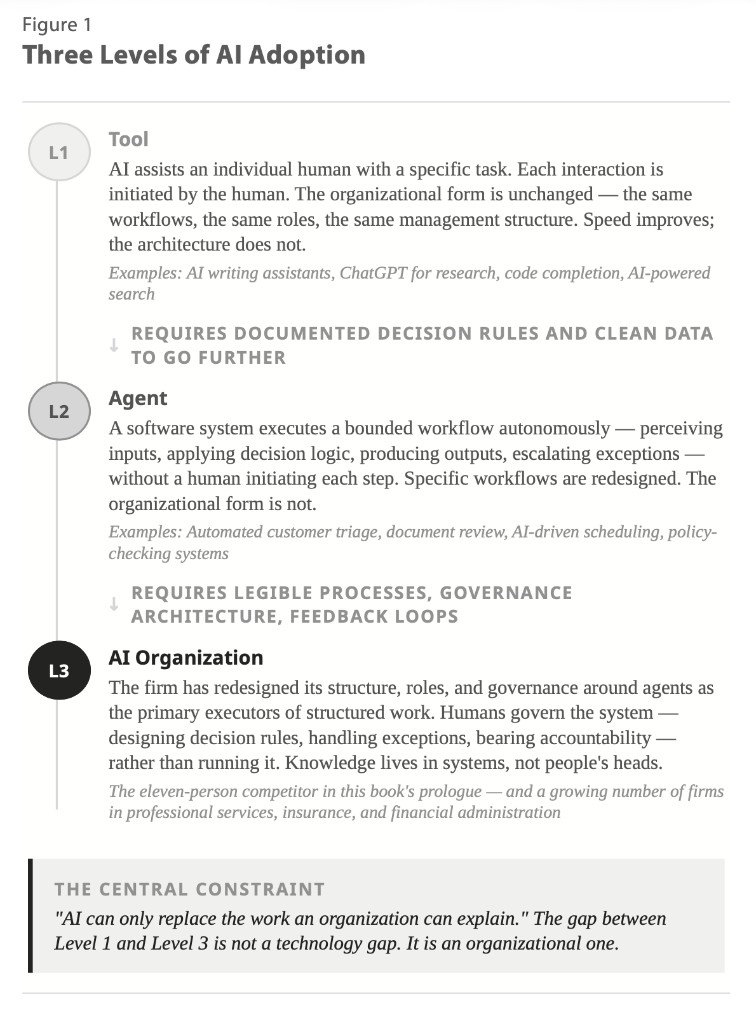
The central claim, stated plainly: The AI organization is not a company that uses AI. It is a company redesigned so that agents execute structured cognitive work, humans govern judgment and accountability, and organizational knowledge lives in systems rather than in people’s heads. That redesign is possible now, is happening in specific industries and specific organizations, and represents the most significant shift in how firms are built since Drucker named the knowledge worker in 1954.
This book is organized as a conversation with the management canon — with the theorists and frameworks that built our current understanding of how organizations work and why. Each one was built for a world of scarce human cognition. Each needs updating for a world where that scarcity is shifting. The core questions each thinker was asking remain the right questions. The answers change when the resource those questions were organized around becomes cheap. Part One establishes why this is a genuine rupture, not an upgrade. Part Two examines what it means for strategy. Part Three asks the harder questions about culture and the human role. Part Four shows what the transformation looks like inside each major business function. Part Five is the playbook. The final chapter, standing alone, asks what builders owe the world they are building.
A note on scope: this theory is most precisely applicable to knowledge-work organizations — firms where cognition, not physical labor or capital equipment, is the primary input and the primary source of margin. Technology companies, professional services firms, financial institutions, marketing and media organizations, insurance, health administration, law, consulting. That is where much of the modern economy’s complexity and margin now lives — and where the organizational disruption will be fastest and sharpest.
A note on the organizations in this book: the Columbus insurance brokerage and the Chicago marketing agency are composite cases, drawn from recurring patterns across real organizations, with identifying details changed. They are included to illustrate common organizational dynamics, not as single documented case studies. All other specific figures, studies, and named theorists are cited as accurately as the research permit
Part One
Drucker was right about the knowledge worker. He just didn’t see what comes after — and neither, for a long time, did anyone else.
General Motors in 1945 was the most complex private organization on earth. It employed 180,000 people across dozens of plants, hundreds of product lines, and a distribution network that reached every county in America. Alfred Sloan had spent two decades building a management structure sophisticated enough to run it — decentralized divisions with central coordination, a professional managerial class with clearly defined authority and accountability, financial controls that gave headquarters visibility without micromanagement. It was, by every measure, a triumph of organizational design. Peter Drucker spent a year inside it. General Motors had invited him in 1943 to study the company as an independent observer — an unusual act of corporate openness for the era. Drucker attended executive meetings, interviewed managers at every level, observed production lines, read internal documents, and tried to understand how an organization of that scale actually functioned. The book he wrote, Concept of the Corporation, published in 1946, was the first serious attempt to treat the large corporation as a subject of intellectual inquiry rather than a vehicle for profit. But Drucker’s real contribution came eight years later, in 1954, in The Practice of Management. The time inside General Motors had left him with a question that the GM study hadn’t fully answered: that kind of industrial organization was becoming one type of company among many. The economy was filling with a different kind of organization — universities, hospitals, research labs, consulting firms, advertising agencies, insurance companies — where the primary output was not physical goods but thinking. Where the workers did not operate machines but made judgments. Where performance could not be measured in units per hour and could not be improved by optimizing physical movements. Drucker named this new kind of worker the knowledge worker. And in naming them, he did something more consequential than coining a term: he identified that they required an entirely different theory of management.
The industrial management tradition, running from Frederick Winslow Taylor through Henry Ford and into the great postwar corporations, was built on a set of assumptions that fit factories and manual labor. Work could be decomposed into its smallest constituent parts. The best method for performing
each part could be identified through observation and experiment. Workers could be trained to execute that method precisely and consistently. Output could be measured in physical units. Supervision meant watching — verifying that the method was being followed and the rate was being maintained. Drucker saw that none of these assumptions held for knowledge workers. You could not decompose a researcher’s work into constituent parts without destroying the thing that made research valuable — the unexpected connection, the reframed question, the persistent curiosity that follows a thread others had dropped. You could not identify the one best method for thinking, because thinking’s value often came from departing from established methods. You could not measure output in units, because the unit of knowledge work — the decision, the analysis, the relationship, the creative act — resisted clean quantification. And you could not supervise by watching, because the work happened invisibly, in minds that you could not observe. His answer was management by objectives. Not managing activity — managing outcomes. Not telling people how to do their work — telling them what the work was for, and trusting them to find the path. Not supervising movement — reviewing results. Not measuring input — measuring impact. This was, at the time, a radical departure. Most organizations in 1954 were still organized around supervision and control. Drucker was arguing that for a growing proportion of the workforce, supervision and control were not just ineffective but actively counterproductive — that the attempt to monitor and direct knowledge workers destroyed the autonomy on which their productivity depended. The manager’s job was not to control but to create conditions: clarity of purpose, appropriate resources, freedom from interference, feedback on results.
Managing knowledge workers means making their strengths productive and their weaknesses irrelevant. It does not mean making them work harder. It means making their work matter.
For seventy years, that insight organized management thinking. The knowledge worker became the central figure of the post-industrial economy. The organizational forms built around them — departments of specialists, hierarchies of coordinators, career paths through growing expertise, performance systems built on goals and reviews — became the default architecture of every firm where thinking was the primary work. Consulting firms, law firms, banks, technology companies, advertising agencies, research institutions, media organizations: all of them built around Drucker’s insight, even when they had never read a word he wrote.
He was right. The insight was correct, consequential, and durable. The knowledge worker was a genuinely new economic unit, and the management theory built around them was genuinely better than what came before. What he couldn’t see was not a flaw in his reasoning. It was a limitation of his moment. In 1954, there was no alternative to human cognition for producing cognitive output. Thinking required thinkers. Research required researchers. Writing required writers. Analysis required analysts. Coordination required coordinators. The scarcity of human cognitive capacity was a natural law of organizational life, as fixed as the speed of light and as universal as gravity. Drucker’s entire theory was built on that foundation — and the foundation, for seventy years, held. It is holding less firmly now.
The word most commonly used to describe what AI is doing to knowledge work is automation. It is the wrong word, or at least an incomplete one. Automation implies a clean replacement: a machine does what a human did, faster and cheaper, and the human is freed or displaced. That model fits manufacturing well. It fits certain categories of cognitive work — data entry, document classification, form processing — reasonably well. It does not fit most of what knowledge workers actually do. What is happening is something more structural than automation. The cognitive output that knowledge workers produce — analysis, synthesis, research, drafting, classification, planning, coordination, monitoring — is becoming available through non-human systems at a marginal cost radically below the cost of human labor performing the same tasks. Not perfectly. Not for every kind of cognitive task. Not in ways that substitute for everything valuable about a human being. But good enough, fast enough, and cheap enough to change the economics of building organizations around paying humans to produce that output. The distinction matters. When a machine automates a factory job, the job goes away and a simpler job — machine monitoring, quality control — sometimes replaces it. When AI makes cognitive output cheaper, the job doesn’t simply go away. It transforms. The task that required a human disappears into a system. What remains is the judgment about whether the system’s output is right, the design of the system itself, the relationship with the person the output serves, and the accountability for outcomes that no system can hold on its own. Drucker’s knowledge worker was defined by the fact that their cognitive output required them specifically — that their expertise, experience, and professional judgment were the irreplaceable inputs to the work. That is still true for some categories of knowledge work. It is decreasingly true for many others. And the line between them is moving faster than most organizations are tracking.
Consider what a mid-level financial analyst at a large bank actually does in a typical week. They gather data from multiple internal systems and clean it into a usable format. They run analyses that have been run before, applying established methodologies to new inputs. They write sections of reports that follow a standard structure, inserting current figures into familiar frameworks. They attend meetings to communicate findings that could, in many cases, be read from a dashboard. They coordinate with colleagues to track down missing information. They update models when inputs change. They respond to requests from senior staff for specific slices of data or specific scenarios. Some of this work requires genuine expertise, judgment, and professional accountability. Some of it is sophisticated but procedural — the application of established methods to familiar problems. Some of it is coordination and communication overhead that exists because the organization is not designed to surface information automatically. And a growing portion of it — data gathering, cleaning, formatting, standard analysis, report drafting, model updating — can be performed by agent systems operating within well-defined parameters, with the analyst’s time freed for the portions that actually require them. This is not the analyst’s fault. It is the organization’s design. The firm was built around Drucker’s assumption: that producing cognitive output required humans, so you hired humans and organized them to produce it. The analyst is doing the work the firm was designed for them to do. The problem is that the design assumption — thinking requires thinkers — is only partially still true, and the portions where it remains true are not the same portions that justify most of the analyst’s week.
The knowledge worker does not disappear in the AI era. They stop being the atomic unit of the organization. That is not a small change.
The most important claim this book makes about knowledge workers is also the most precise one. It is worth getting it right. The knowledge worker category does not collapse. It subdivides. On one side of the subdivision is what this book calls the execution worker: the knowledge worker whose primary value was the production of cognitive output — analysis, drafting, research, classification, coordination, monitoring. This is not a demeaning category. It describes a large portion of the work that highly educated, well-compensated professionals spend their time doing. It describes work that was genuinely valuable and genuinely difficult before AI, because producing it required rare human skills. It is the category that is most directly affected by AI’s ability to produce cognitive output at low marginal cost. Not eliminated — transformed. The execution worker’s relationship to their
work changes: they shift from producing the output to governing the systems that produce it. On the other side is what this book calls the judgment worker: the knowledge worker whose value comes not from cognitive output but from the human properties that attach to their specific participation — their accountability, their relationships, their authority, their moral weight, their accumulated wisdom about a particular domain and a particular set of people, their ability to be genuinely present with another human being in a consequential moment. The doctor whose diagnosis carries weight not just because it is accurate but because a trained, experienced, accountable human being made it. The lawyer whose advice is valuable not just because it is legally correct but because they understand the client’s actual situation, tolerances, and relationships in ways that informed the advice. The sales leader whose deal closes not because the proposal was better but because they had built genuine trust over years of honest engagement. These categories are not perfectly clean. Most real knowledge workers do both kinds of work, in varying proportions. The financial analyst does some execution work and some judgment work in the same afternoon. The surgeon does some execution work — following established protocols, applying standard techniques — and some judgment work — reading the specific situation, deciding when the protocol doesn’t fit, holding accountability for outcomes. The manager does execution work in every meeting where the update they’re gathering could have been surfaced automatically, and judgment work in every conversation where a person needs to be heard, redirected, or supported in a way that no system could deliver. The distinction matters not because it cleanly divides people into categories but because it divides work into categories — and the proportion of each in any given role determines how that role is affected by AI, and how the organization that contains it should be redesigned. Organizations built around Drucker’s knowledge worker treated execution and judgment as inseparable, because they were performed by the same person and could not be disaggregated. The analyst did both. The manager did both. The lawyer did both. AI makes disaggregation possible — and in doing so, creates both an opportunity and a challenge. The opportunity: concentrate human time on the judgment work that actually requires it, and let systems handle the execution work that doesn’t. The challenge: most organizations have no clear picture of which parts of which roles are which — and the redesign required to disaggregate them is the hardest organizational work there is.
The dominant mental model for how AI enters organizations is the copilot. An AI assistant attached to each existing knowledge worker, helping them work
faster. The email drafted in seconds instead of minutes. The research summarized rather than read in full. The presentation slide generated from a bullet point. The code written by an assistant rather than from scratch. The copilot makes the existing worker more productive. The organization remains the same. Everyone keeps their job and gets faster. The copilot model is not wrong. It describes something real that is happening in millions of organizations right now, and it produces genuine productivity gains. The problem is not that it’s false but that it’s small — and that its smallness is systematically obscured by how organizations measure progress. Here is what the copilot model does not change: the organizational architecture. The firm is still built around the knowledge worker as the atomic unit. The copilot makes each atom faster. The number of atoms, and the relationships between them, and the workflows that connect them, and the processes that coordinate them, and the management layers that supervise them — all of this remains unchanged. The organization adds capability at the individual level without redesigning at the system level. This is the organizational equivalent of giving everyone a faster horse. The people move quicker. The roads, the settlements, the economic relationships built around horse-speed travel — all of it remains. The automobile’s disruption wasn’t that it made individual horses faster. It was that it made an entirely different organizational logic possible: faster roads, suburbs, supply chains, distribution networks, forms of work and life that the horse economy couldn’t support. Organizations that understood the automobile redesigned around it. Organizations that bought faster horses eventually faced the automobile anyway, less prepared. The AI organization does not attach AI to the existing worker. It redesigns the work around AI. The question it asks is not: how do we give everyone a better tool? It is: if we were designing this workflow from scratch, knowing what agents can do, would we design it the way we designed it? And if not — how would we design it differently, and what does that imply about the humans we need, in what roles, doing what specifically? The difference is concrete. In a traditional knowledge-work organization, a customer request arrives by email. It gets forwarded to an account manager, who checks it against policy, escalates to a senior colleague for pricing approval, waits for a response, drafts a reply, and sends it — two days later, after five human touches. Each touch is a coordination cost. Each handoff is a place where context is lost, delays accumulate, and errors are introduced. The account manager spends perhaps forty percent of their day on work of this kind: competent, necessary, and structurally identical to what their colleagues are doing simultaneously across the organization. In the AI organization, the same request arrives. An agent classifies it, retrieves the relevant account history and policy documentation, checks whether it falls
within approved response criteria, drafts a response, and sends it — in minutes, logged to the audit trail, with the exception cases routed to a human. The account manager’s day is not the same day with less email. It is a structurally different day: reviewing exception cases, refining the decision criteria the agents apply, managing the client relationships where trust and judgment genuinely matter, and doing the work that the agent cannot do because it requires someone to be accountable rather than just correct.
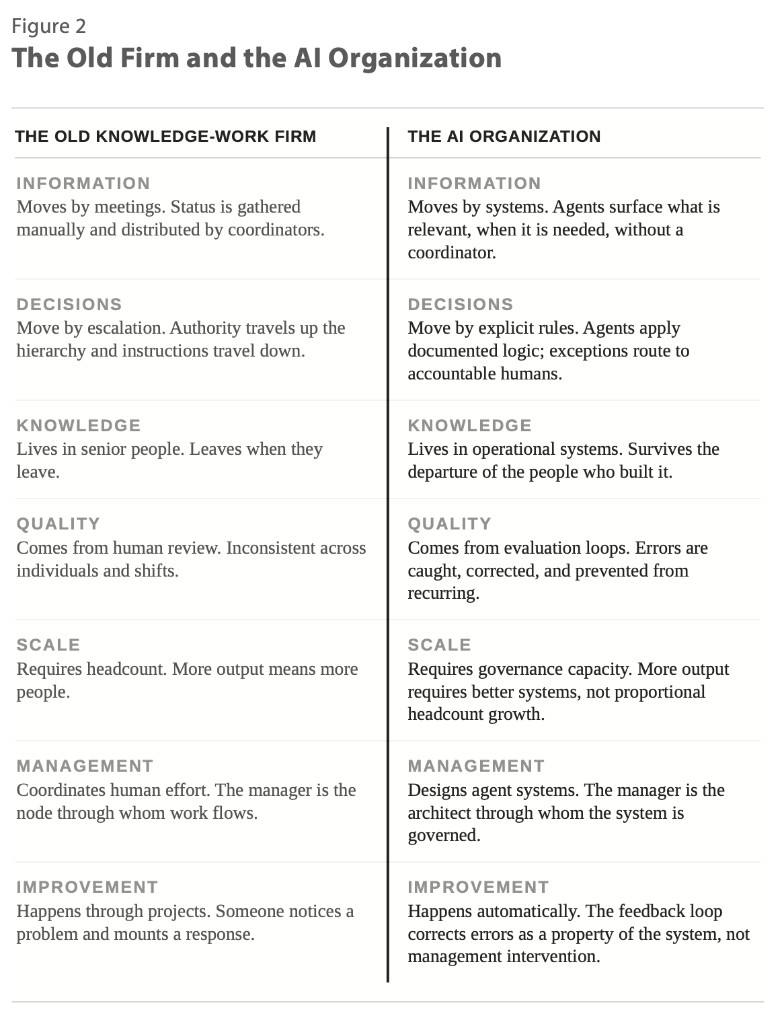
The copilot version of this story gives the account manager an AI assistant that helps them draft the reply faster. The organizational form is unchanged. The AI organization version changes the organizational form: the agent handles the execution, the human handles the governance, and the relationship between the two is explicitly designed rather than left to individual improvisation. That question is more uncomfortable than the copilot question, because it requires examining organizational structures that have accumulated over decades, that people have built careers around, and that represent real power and real identity. It is also more valuable, because it is the question that leads to the compounding advantages — the continuous improvement, the lower cost structure, the faster response time, the ability to scale without proportional headcount growth — that are increasingly separating AI-native organizations from their copilot-equipped competitors.
The pilot is where AI transformation goes to avoid becoming organizational transformation.
There is a name for the pattern. Call it AI theater: when an organization performs transformation without changing its operating model. Copilots for everyone, but no workflow redesign. Pilots everywhere, but no production ownership. AI strategy decks, but no data cleanup. Innovation teams, but no authority to change the org chart. Chatbots on top of broken processes. Productivity claims without measurable changes in cycle time, error rate, or intervention rate. AI theater is what happens when executives want the appearance of transformation without the organizational consequences of transformation. It is, at this moment, the most common AI strategy in large organizations. Most organizations are caught between these two modes. They have deployed copilots — ChatGPT accounts, AI-assisted writing tools, code completion, research summarization. They have run pilots — workflow automation experiments, agent deployments in specific departments, proof-of-concept projects that demonstrate AI can do something. And then they have struggled to cross from the pilot to the production deployment, from the productivity gain to the organizational redesign, from using AI to being what this book calls an AI organization. The crossing is hard. It requires confronting process debt — the accumulated organizational dysfunction that copilots can paper over but AI-native systems expose. It requires making implicit knowledge explicit, writing down decision rules that have lived in people’s heads for years, documenting processes that survived on institutional memory. It requires a kind of organizational honesty that is genuinely difficult for organizations that have been successful precisely
because talented people improvised their way through broken systems and nobody needed to acknowledge the brokenness. Chapter Three is about that crossing. This chapter is about understanding why it’s necessary — about seeing the Druckerian assumption for what it is: a theory built for a specific scarcity that is changing, and an organizational form that will need to change with it.
Drucker himself sensed the question coming. He died in 2005, at the age of ninety-five, active and writing almost until the end. In his later work he had begun to grapple with the knowledge economy’s limits — with the question of what came after knowledge work as the primary economic activity, with the problem of knowledge worker productivity as the central management challenge of the coming decades. He wrote, in 1999, that “the most important contribution management needs to make in the twenty-first century is similarly to increase the productivity of knowledge work and the knowledge worker.” He framed it as a continuation of the productivity revolution that Taylor had begun with manual workers — applying the same discipline of analysis and improvement to the harder problem of knowledge work. He was pointing in the right direction. He anticipated that the management challenge would shift from organizing knowledge workers to improving their productivity. He did not anticipate the mechanism — that the productivity improvement would come not from better management of knowledge workers but from systems that could produce cognitive output without them, for a growing range of tasks. But the spirit of his inquiry was exactly right. Drucker was not attached to organizational forms for their own sake. He was relentlessly focused on the underlying question: what does the organization need to accomplish, and what is the most effective way to accomplish it given the resources and capabilities available? He changed his answers as the economy changed. The Practice of Management was not his final word — it was his answer for 1954. He would have updated it. What he would have insisted on, and what this book insists on in his spirit: the organizational form must follow the economic reality, not the other way around. If the economic reality is that cognitive output is becoming available through non-human systems at radically lower cost, then the organizational form built around the exclusive human production of cognitive output must be examined and, where necessary, redesigned. Not because the knowledge worker is obsolete — they are not — but because the organization built around them as the only source of thinking is. And the gap between what organizations currently are and what they need to become is what the rest of this book is about.
Peter Drucker 1954 / 1959 Management by Objectives & The Knowledge Worker Original theory Knowledge workers create value through thinking, not physical labor, and cannot be managed through supervision or standardization. Management by objectives provides coordination through goal alignment rather than activity control: set clear objectives, give workers autonomy to find their own path, measure results. The manager’s job is to make knowledge workers’ strengths productive and their weaknesses irrelevant.
The reframe MBO assumed that setting goals was the primary coordination mechanism — that autonomous human judgment, directed toward shared objectives, would produce organizational outcomes. This assumption held as long as executing the work required human cognitive capacity. When agents can execute the structured portions of knowledge work, the coordination problem changes: you are not aligning human judgment through objectives, you are designing decision systems that execute those objectives and surfacing the exceptions that require human judgment. MBO’s objectives become evaluation criteria for systems, not motivational targets for people. The knowledge worker’s role shifts from producing cognitive output to governing the systems that produce it and handling the judgment the systems cannot.
New paradigm The knowledge worker subdivides into execution workers — those whose structured cognitive tasks agents now perform — and judgment workers — those whose value is irreducibly contextual, relational, and accountable. Management theory must address both categories with different tools. The tools for managing agents are not the same as the tools for managing people, and the tools for managing judgment workers are not the same as the tools for managing execution workers.
The Counter The knowledge worker category is not being disrupted — it is being elevated. AI handles the execution of cognitive tasks, freeing knowledge workers to operate at higher levels of abstraction and judgment than was previously possible. The financial analyst who no longer spends Tuesday gathering data can spend Tuesday thinking about what the data means and what should be done about it. Far from becoming redundant, knowledge workers in AI-assisted firms are more valuable than ever — they are doing the work they were always supposed to be doing, without the organizational overhead that consumed most of their time. The threat is not displacement but irrelevance for those who refuse to work at the new level. And ‘refusing to work at the new level’ describes relatively few people when the alternative is presented clearly. Most knowledge workers would prefer to think than to gather data. Give them the tools to do so and they will use them.
The objection has real force. It describes something true about what happens to the best knowledge workers in the best AI-native organizations — they do work at a higher level, they are more valuable, and most of them find the transition liberating rather than threatening. It also describes something incomplete. It assumes that the organizational redesign required to get there happens smoothly, that knowledge workers make the transition effectively, and that organizations can identify and preserve the judgment work while offloading the execution work without disrupting the relationships, identities, and power structures built around the current arrangement. None of that is guaranteed. Most of it is hard. It also sidesteps the deeper question: if the execution portions of knowledge work can be performed by agents, what are the implications for how many knowledge workers an organization needs? If the analyst who was spending 60% of their week on execution work can now spend 100% of their week on judgment work — that is a genuine gain in value per person. It is also a reduction in the number of analysts needed to produce a given quantity of analytical judgment, once the execution overhead is removed. Organizations that are honest about that arithmetic will make better decisions than organizations that treat the productivity gain as pure addition — more output from the same people — without examining what the changed economics imply for organizational design. The AI organization is not the existing organization with everyone promoted. It is a different organizational form with a different headcount, a different structure, and different requirements for the humans it employs. Drucker would have recognized this. His life’s work was the discipline of examining organizations as they actually are, not as their participants wished them to be, and designing them for what they needed to accomplish rather than what they had historically done. That discipline — unsentimental about organizational forms, relentlessly focused on purpose and performance — is what this chapter is trying to honor. The knowledge worker was his answer for 1954. The AI organization is the answer for now.
About the book
The AI Organization argues that AI-native firms will not win because they use better software. They will win because they redesign management around judgment, governance, and compounding learning.
Frequently asked questions
An AI organization is a firm redesigned so that agents execute structured cognitive work, humans govern judgment and accountability, and organizational knowledge lives in systems rather than only in people's heads.
An AI tool helps an individual human complete a task faster. An agent executes a bounded workflow autonomously. An AI organization redesigns structure, roles, and governance around agents as primary executors of structured work, with humans governing the system.
Process debt is the accumulated organizational dysfunction that prevents a firm from using AI at depth: undocumented decisions, hidden workarounds, broken handoffs, unclear ownership, and knowledge that exists only in senior people's heads.
It means agents can execute work only when the organization has made the relevant process, data, policy, permissions, and decision logic explicit. Work that depends on unwritten judgment or hidden context still requires humans.
Copilots can make individual workers faster, but they usually leave the organizational architecture unchanged. The deeper advantage comes from redesigning workflows, governance, and learning loops around what agents can execute.
Free with your email
Enter your email and I will send the PDF attachment.
No spam. One email with Chapter One. Unsubscribe anytime. Privacy policy.
Ready for the full book? Buy it on Amazon.